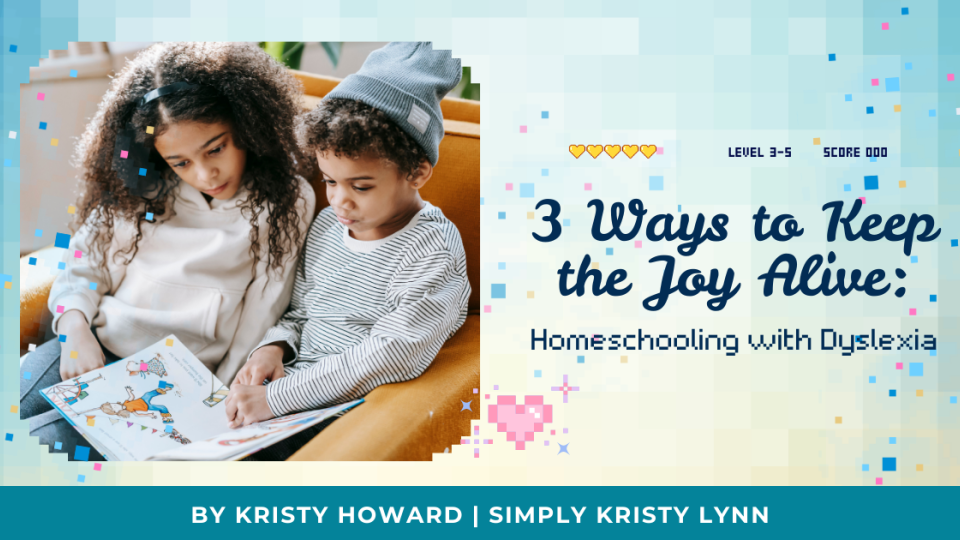
By Kristy Howard of Simply Kristy Lynn
Three of my five kids have dyslexia.
Reading and writing are my superpowers—my most enjoyed pastimes and (ironically) what I do to earn a living.
So no, homeschooling with dyslexia wasn’t something I planned for. Or something I had any idea how to navigate as a young mom.
Over the years, I’ve learned a lot about what does—and definitely doesn’t—work when it comes to helping my kids with reading struggles.
Hint: there’s no perfect curriculum or one-size-fits-all strategy.
There’s only patience. Time. And the grace to enjoy the parts of learning (and life) that don’t feel so impossible in the moment.
If you’re deep in the trenches with a struggling reader, I want to share three things that have made all the difference for us—three ways we’ve kept the joy alive, even when progress felt painfully slow.
1. Get a Hobby
Yes, you, Mama.
I know that sounds counterintuitive in an article about your dyslexic learner, but hear me out.
As homeschool moms, we get a lot of advice about pushing through. About not giving up. About being the steady, dependable force for our kids—and all of that is true. It’s good. It’s needed.
But you weren’t made to just survive your way through motherhood (or homeschooling).
You need something that lights you up. Something outside of school planning and phonics lessons and “try that word again, sweetheart.”
Years ago, I picked up writing again—not just for curriculum or lesson plans, but for myself. It grounded me. Gave me something to look forward to. Something that reminded me I’m more than just a teacher or tutor.
Maybe for you, it’s knitting, gardening, painting, or baking sourdough (because of course). Whatever it is, let it be yours. Even 20 minutes a few times a week is enough to remember who you are—and help you show up with more joy.
2. Help Your Child Get a Hobby (or a Passion)
Dyslexic kids are often very aware of what they’re not good at—especially if that thing is reading.
So, one of the best gifts you can give them? A sense of identity that has nothing to do with academics.
I’ve seen this over and over in my own kids, and the students I’ve worked with in our homeschool community:
Dyslexic kids are wildly creative. Intensely curious. Often gifted in ways traditional education never quite knows how to measure.
One of my daughters is a musical theatre major now—memorizing scripts and stage directions with more ease than you’d expect.
My oldest son has a mechanical mind and, ironically, can spout off history facts like nobody’s business. Another son has an incredible eye for light, texture, and photography.
They’ve all had to work hard for literacy milestones. But they’ve also learned that they are so much more than their reading level.
Help your child discover what makes them come alive. It doesn’t have to be fancy or expensive—just something they can enjoy, excel in, and grow with.
4. Embrace the Long Haul
This isn’t the part anyone wants to hear. But if you’re going to homeschool a child with dyslexia, you need to go in with realistic expectations.
This is not a summer intensive. There’s no magical breakthrough. No “aha moment” that fixes everything overnight.
Dyslexia is a lifelong learning difference. That doesn’t mean your child won’t succeed. It just means it’ll take time—and lots of it—to build the tools they need to thrive.
Reading progress may happen slowly. Sometimes in spurts. Sometimes with long plateaus in between.
But if you stick with it, and get the right support, your child will grow into a confident learner.
We’ve used tutors, specialized reading programs, audiobooks, and even color-coded overlays. Not everything worked for every child, but over time, we found what helped.
And more importantly, we kept our relationship intact.
Because joy in homeschooling isn’t just about checking boxes or finishing curriculum. It’s about preserving wonder, connection, and a vision for the long view.
Final Thoughts
Homeschooling with dyslexia will stretch you. It will challenge your expectations, your schedule, and your patience.
But it can also make you a better mom, and a deeper educator. It can open your eyes to how wonderfully varied and creative God made our children—and how education doesn’t have to look like a straight line.
So if you’re weary, start small. Get a hobby. Encourage theirs. And keep showing up with love and faithfulness.
This road may be longer than you planned—but it’s one worth walking.

Read More!
- Log in to post comments