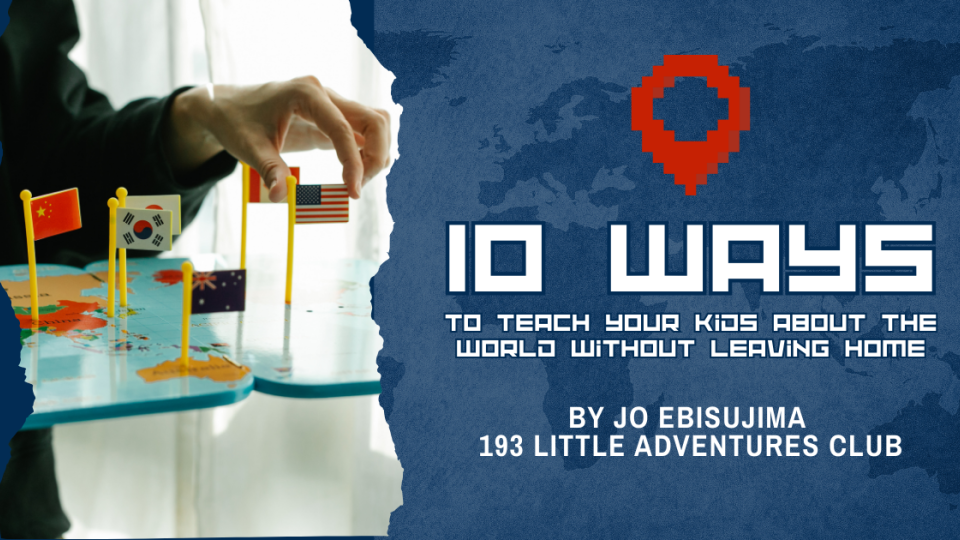
By Jo Ebisujima of 193 Little Adventures Club
The world is full of incredible cultures, breathtaking landscapes, and fascinating wildlife. As parents, we want our children to explore it all. But let’s be honest, we can’t always just hop on a plane every time we want to experience a new place.
The good news? You don’t have to travel to bring the world into your home!
Here are 10 ways you can add some worldly education into your days without digging out your passport or packing a case. Help create curiosity by asking questions.
Some of these examples you will be able to do straight away, others you will need to collect items. Asking friends and family if they have anything they can donate to your world studies, is an easy way to boost your collections.
1. Music
Pick a country, then search for its music, traditional folk songs, modern pop hits, or even national anthems. YouTube often features performances with traditional costumes and dance. Compare the sounds to your own country’s music. What instruments do you hear? Make a daily clean-up routine, pick a country, find a song as and tidy up!
2. Money
Kids are often fascinated by foreign money. Australian notes are very colorful and made of a type of plastic. Swiss francs are also colorful and have a vertical design rather than the usual horizontal.
Some countries have coins with holes in them or made of two metals. The UK has 2 coins that are heptagonal, Aruba has a square 50c coin. And then there are the designs, animals, landmarks and famous people which can all be researched.
If you don’t have foreign currency at home, look it up online. You can even challenge your child to design their own banknote for a made-up country, what colors, symbols, and historical figures would they include?
3. Food
Food is one of the best ways to experience another culture. You can go all out with a home-cooked meal inspired by a country or keep it simple, try a new fruit, snack, or drink from the store. Explore the textures and flavors together, what does it remind you of? Could you imagine eating this every day?
4. Stories
Many fairy tales originate from foreign lands and have been translated into English. Together you could research the origins of your favorite stories. Or head to the library and find traditional stories, many of them are based on folklore that share a common thread.
Most countries have their own version of the water demon who snatches children that play near water, for example.
5. Postcards
Receiving postcards is exciting, but sending them is just as fun! Consider joining a postcard swap or writing to a pen pal from another country. What would your child say about where they live?
Postcrossing.com is a great place to start. Picture postcards are great conversation starters, and then there is also the postage stamp.
6. Google Earth
Using Google Earth, try ‘walking’ around a place and imagining what it would be like to stand there in real life. From the great bazaars of Iran to the Eiffel Tower.
Then close your eyes, what do you think it smells like in a spice market in Morocco? What sounds would you hear in a Tokyo train station?
7. Festivals and Traditions
Every culture has unique festivals, some well-known, like Diwali, Kwanzaaand May Day, and others wonderfully quirky, like Finland’s Heavy Metal Knitting, English Cheese Rolling or Japan’s Crying Baby Sumo.
Research a festival, then celebrate it at home—make a craft, try a special dish, or watch a related documentary!
8. Movie Night
Possibly the easiest of them all!
Movies are an easy way to explore new cultures. Try watching a film set in another country or even in a different language. If your child resists subtitles, remind them that for many people, reading subtitles is the only way to enjoy movies.
A simple scene can spark great discussions. Why do many Asian families take their shoes off indoors, while American movies often show people wearing shoes on the sofa? Why is a family bathing together normal in Japan but uncommon elsewhere?
9. Language
Native English speakers have a bit of a reputation for being lazy when it comes to learning a second language.
Even if you have no intention of travelling, it is always good to try and learn a new language, as it gives you a better appreciation of how hard it can be.
Learning a few words in another language is a great way to connect with a culture. Start simple, learn how to say ‘hello’ in 10 different languages, or try counting to ten. Want to go further? Challenge your family to a ‘word of the day’ or watch a short cartoon in a foreign language.
10. Follow their lead
If your child has a passion, whether it’s horses, football, or art, use it as a gateway to explore the world! Love ponies? Discover why Icelandic horses have an extra gait and how Mongolia’s wild Przewalski ponies were bought back from near extinction.
Obsessed with football? Learn about Ronaldo’s birthplace, Madeira. Budding artist? Take a world tour through Monet’s gardens or Frida Kahlo’s home in Mexico.
Bringing the world into your home doesn’t have to be complicated. Whether you try one idea or dive deep into a country, the goal is the same, fostering curiosity, appreciation, and a love for learning about the world. So, where will your next adventure take you?

Read More!

- Log in to post comments