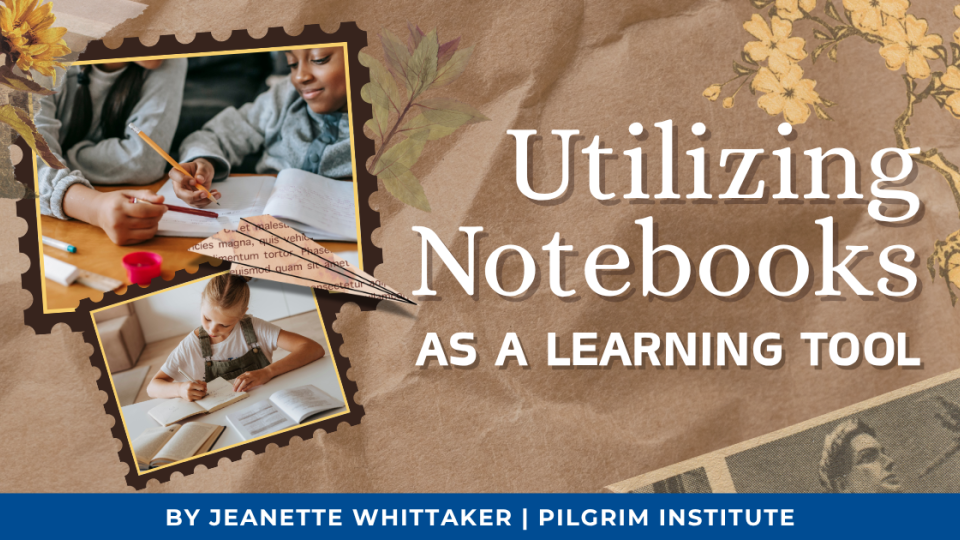
By Jeanette Whittaker of Pilgrim Institute
One of the tools in your education toolbox involves some form of keeping a notebook.
Notebooks offer flexibility, are effective for any learning style, accommodate multi-level learning, encourage enjoyment in learning, and involve your student in taking ownership of their education.
Because I grew up keeping notebooks, I offered paper and pencils to my children when they were very young. Their writing and drawings are now special keepsakes!
Whether you teach one student or several, early learners or high school, are a veteran homeschool family or just getting started, you have an amazing array of educational resources at your disposal.
How Does Writing Help Learning?
Perhaps you’re curious about why families would invest time recording highlights of learning into notebooks.
Studies show that writing by hand helps us remember and improves our thinking skills.
If you’re wondering about that, think about a time you forgot a handwritten list of errands to run or items to purchase, but were able to remember what to do simply because you had taken the time to write a list.
Chances are, you now use digital tools for list-making, schedules, etc. Nevertheless, writing by hand remains a valuable educational tool.You may wish to look into studies documenting how students demonstrate improved learning outcomes when they write by hand.
How Should I Begin?
Perhaps you’re hesitant about the time required to keep a notebook. Writing in a notebook can be as simple or as complex as you and your students choose to make it.
If you would like to “dip your toe in the water,” get started with a blank book!
Ask your kids to write about their experiences: what they see and hear in the backyard, favorite parts from books they are reading, what they learned by visiting a park or museum, interesting animals they saw at the zoo, or special take-aways from a place they visited.
Any sort of journaling is a valuable learning tool.
I recall coming inside from an outdoor walk and inviting my students to write about what they had seen or heard. One asked, “May I write a poem?” It was easy to say, “Yes!”
Focus On Main Ideas
If you haven’t ventured into keeping a notebook yet, think of it as a way to put your learning on display.
Choose a topic, unit, or subject, and begin recording the main ideas from your lessons.
Perhaps you read something together, and discussed it. Writing is a wonderful way to record and remember what you learned.
For younger students, or older students just getting started, have a written summary statement, list, diagram, etc. for them to copy word for word.
For example, if you were learning about what plants need in order to grow, your notes might look something like this (based on your students’ ages):
What do plants need?
- Light
- Water
- Air (Carbon dioxide)
- Soil (Nutrients, a place for the root system)
- Space to grow
Take the time you need to adequately understand the concept first and then record it in the notebook.
Use The Notebook To Review & Remember
Does it seem helpful to refer back to your notes in order to complete assignments, review, and reinforce learning? Definitely!
Are you teaching multiple ages? Adjust the notebook to the age and capacity of your students.
In the example above, older students could be asked to add the specific nutrients plants draw from the soil.
What if students are not writing yet?
Early learners can be encouraged to make drawings about what they are learning. This is a great way to involve them alongside your older students, so that you are teaching multiple levels at the same time.
A slightly older child might draw a picture and write a word or brief sentence to go with it.
The notes listed above could be simplified to, “Plants Grow.” Their illustration could include sun behind clouds, soil, and rain.
Let Note-Making Advance With Practice
As your students grow, their skills will develop further. In time they will write two or more sentences. Then they will write paragraphs, summaries, sketches, and more.
By middle elementary, your kids should be ready to copy the sample notes suggested above in the course of one lesson.
Take Notebooks To The Next Level
During middle and high school years, you may extend their learning by assigning specific topics for your kids to research independently.
For example, you could assign them to explain photosynthesis.
By doing the research themselves, they would be “discovering” rather than relying on you to present lesson content.
Discovery-based learning is highly effective, because the student has invested their own reasoning skills to find out about a topic, solve a problem, or simply learn about something they find interesting.
How Should A Notebook Be Organized?
Getting off to a good start helps you and your students.
Use tabbed dividers to separate subjects, units, or sections. You might want dividers labeled:
- Notes
- Assignments
- Tests
Think about your students’ ages and choose a plan that best fits your family.
What Subjects Should We Choose?
Your kids can make a notebook about any topic or subject.
Perhaps you are reading aloud or studying a literary work together. Use the notebook to write about individual characters, along with descriptions about them, obstacles they face and overcome, how they grow and develop through the challenges, and the valuable lessons to be gleaned from their story.
As you learn history, use the notebook for timelines, maps, documents, and notes about important individuals and events. Find speeches, newspaper articles, or letters for first-hand accounts from the time period. Include quotes from leading individuals, and possibly photos or paintings. The Library of Congress is a great place to find resources about American history.
How Does The Notebook Reflect Your Student's Individuality?
Allow your kids to incorporate their unique talents into their notebook! Adding drawings, writing stories, or creating diagrams will make it personal.
Ask your students for input and suggestions. You might say, “What should we include in our notebook about how plants grow?”
By involving your kids in the process, you foster productivity and cultivate imagination!
Where Can I Find Help?
If the process sounds daunting, be assured that there are curriculum resources intentionally designed for students to use notebooks. Look for notebook-focused online curriculums or go to your local library to find inspiration!
Notebooks: a Versatile, Learning Tool
However you choose to incorporate notebooks in your home, be assured that your students will benefit. Watch for their writing skills to develop, their enthusiasm for learning to grow, and their individual gifts to blossom

Read More!
- Log in to post comments