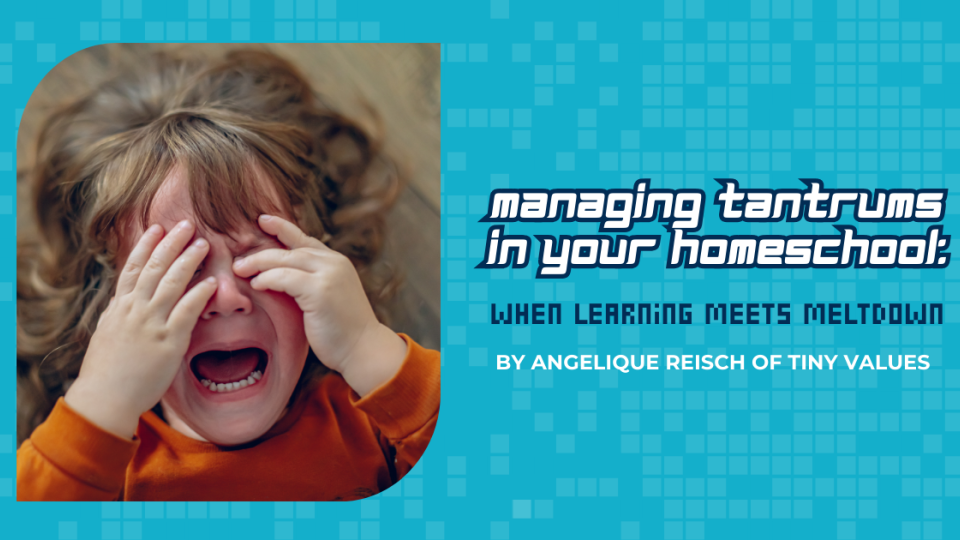
By Angelique Reisch of tiny values
You're halfway through a carefully planned history lesson when your 8-year-old throws his pencil across the room, dissolving into tears because he can't get his timeline dates in the right order. Meanwhile, your 5-year-old has abandoned her math worksheet to crawl under the table, refusing to come out.
Just another Tuesday in your homeschool journey. :)
Even the most seasoned homeschool parents face the perfect storm of academic frustration, developmental challenges, and the unique dynamic of being both parent and teacher. But understanding what's happening in your child's brain during these moments can transform how you respond—and how quickly everyone gets back on track.
Emotional Flooding
Research shows that when a child melts down during lessons, they're experiencing what neuroscientists call "emotional flooding."
This state occurs when the lower brain (including the amygdala—the brain's alarm system) takes over, while the prefrontal cortex—responsible for planning, reasoning, and self-control—becomes less active.
Studies in developmental neuroscience reveal that this brain state makes it physically impossible for children to:
- Process complex instructions
- Think logically about consequences
- Recall previously learned information
- Regulate their emotional responses
Interestingly, research suggests that homeschooled children often experience a different flavor of academic meltdowns. The parent-teacher relationship creates a unique dynamic where children may feel safer expressing frustration with parents than they would with classroom teachers, yet also might feel heightened pressure to perform for the adults they're most attached to.
Age-Specific Regulation
Preschool Ages (3-5)
At this stage, children are just beginning to develop self-regulation skills while their emotional responses are often intense and immediate.
Their developing brains have minimal filtering capacity, and their emotions can switch from joy to distress in seconds.
Try This:
The "Feeling-to-Movement" Approach when frustration appears during learning activities:
- Immediately shift to movement that matches their energy
- Provide language for the transition: "Your body needs to jump now!"
- Direct the movement with purpose: "Jump like you're getting all the mad out"
- Gradually guide toward calming movements: "Now let's be falling leaves"
- Return to learning with a slightly modified activity
Research shows that preschoolers can't effectively "talk through" emotions, but they can move through them. The key is treating the movement not as a distraction or reward, but as a necessary regulatory tool.
Learning Environment Hack:
The "Almost-Impossible, Then Easy" Sequence Research on optimal challenge suggests that preschoolers respond well to:
- A brief (30-second) playful exposure to something slightly beyond reach
- Followed immediately by a similar but highly achievable task
- Celebration of success
This sequence builds frustration tolerance gradually while maintaining confidence.
For example, asking them to write their name in tiny spaces (challenging) before offering appropriately-sized paper (achievable).
Elementary Ages (6-9)
These children are developing metacognitive skills but still struggle with emotional regulation during cognitive challenges.
Try This:
The "Frustration Station" Create a designated space with:
- A visual timer
- Sensory tools like therapy putty
- A feelings chart with specific academic frustrations
- Quick brain reset activities
When frustration builds, direct them to the station with: "I can see this is getting tricky for your brain. Take a 3-minute reset at the Frustration Station, then we'll try a different approach."
What makes this effective is teaching children to recognize cognitive frustration before it becomes emotional overwhelm.
Middle Ages (10-12)
These students experience heightened self-awareness and comparison with peers, even in homeschool settings.
Try This:
Academic Emotion Coaching When you see frustration building:
- Label the learning emotion: "It looks like you're feeling discouraged about this algebra problem"
- Normalize the challenge: "Many mathematicians felt stuck at first"
- Create a collaborative approach: "Let's be math detectives together"
- Provide specific process praise afterward: "You stayed with that problem even when the solution wasn't obvious"
This approach acknowledges your child’s frustrations, provides assistance, and praises the final outcome - making a difficult assignment a more positive experience for you both.
The Homeschool Advantage
While tantrums during lessons can feel disruptive, homeschooling offers unique advantages for handling them:
Flexibility:
Unlike traditional classrooms, you can pivot immediately—putting the challenging subject aside and returning when the brain is receptive, a benefit highlighted in homeschool education research.
Deep Knowledge:
You understand your child's triggers, learning style, and recovery patterns better than any classroom teacher could.
Integration:
You can transform tantrum moments into character development opportunities that seamlessly blend with academic goals, an approach supported by collaborative problem-solving models.
Veteran homeschool mom of four, Michelle Taylor, shares her hard-won wisdom: "I finally realized that meltdowns aren't interruptions to our homeschool day—they're actually part of the curriculum. My kids are learning emotional intelligence alongside history and math, which might be the most important subject of all."
Your Secret Weapon:
The most effective tantrum management happens before the pencil flies. Try these proactive strategies:
The 80/20 Approach:
Schedule 80% confidence-building review and 20% challenging new material, a principle derived from research on optimal learning zones
Body-Brain Connections:
Incorporate movement breaks before cognitively demanding subjects, supported by extensive research on exercise and brain function
Meta-Moment Planning:
Practice specific phrases you'll use when you feel your own frustration rising. And feel free to model self-regulation by taking a break in the frustration station yourself.
Remember: Your response to their tantrum teaches more than any curriculum ever could. When you stay regulated during their dysregulation, you're modeling the very skills they're working to develop.
So the next time your living room transforms into “Tantrum Central” during your carefully planned lesson, take heart. You're not just teaching subjects—you're teaching brains how to handle challenges. And that might be the most valuable homeschool lesson of all.

Read More!

- Log in to post comments